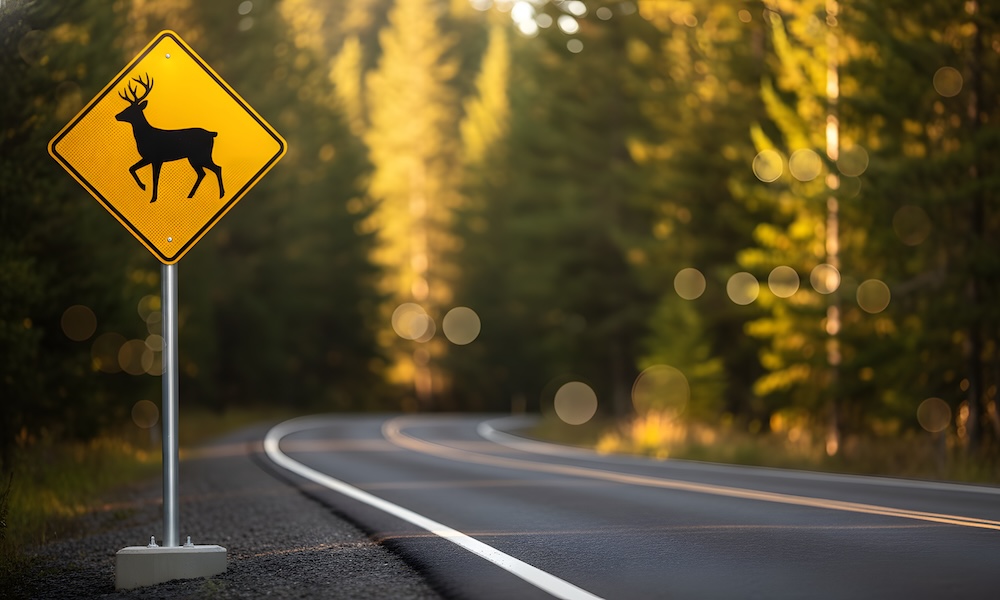
Autumn in Southeastern Pennsylvania means beautiful foliage, crisp air, and one of the most hazardous driving seasons of the year: Deer Season. As deer activity peaks across Montgomery and Bucks Counties, driving during low-light hours takes on a higher than usual level of risk.Local roads, backroads, and busy highways like Rt. 309 are all fair game for deer crossing, with results that range from annoying to catastrophic.
If you hit a deer, or if a deer hits you, knowing how your auto insurance policy applies plays a big role in reducing your stress and out-of-pocket costs. It’s a little easier to calm your nerves and think through the next steps when you know which coverage applies, what your deductibles are, and the impact of filing a claim. At Smyrl Insurance, we have taken hundreds of calls related to deer incidents, and our team is dedicated to helping our clients understand the next steps.
Accidents Involving Deer: Comprehensive or Collision Coverage?
When a deer is involved in an auto accident, the big question to determine whether your claim falls under comprehensive or collision coverage is what your vehicle actually hit.
Direct Impact with a Deer is Comprehensive Coverage
If you run into a deer that runs out in front of you, or a deer runs into the side or back of your car, the resulting damage would be handled under your comprehensive coverage, which may be listed on your policy as “Other than Collision.” Even though you were technically involved in a collision, animal impacts are not considered crash events. They are categorized with other no-fault types of damage such as vandalism, falling objects, broken windshields, and fires or floods.
Because the events that fall under comprehensive coverage are all completely unpredictable, the deductibles for these claims are relatively low. Comprehensive deductibles are typically $250,$500, or $1,000 for damage to the body of your car, while a windshield deductible might be as low as $50 to $100. Deductibles for comprehensive coverage apply for every claim, meaning that if you hit another deer three weeks later (we’ve all heard those stories), you will still have a deductible on the new claim.
Impact with Another Car or Object is Collision Coverage
If you react to a deer running into the road, and your reaction ends in your car hitting another car, tree, guardrail, mailbox, or retaining wall, your damage is classified as a collision. Unfortunately, this is more likely to be labeled “at-fault” by your insurance company. Deductibles for collision coverage are higher than comprehensive ($1,000 to $2,500), and you may also end up with liability and property claims from other parties.
Swerving to avoid an object is often an instinctive move, but it is rarely the best decision for the circumstances. Defensive driving skills are especially important for keeping control of your car in unpredictable moments. If it has been a while since you thought seriously about making split-second decisions behind the wheel, consider brushing up on your driver’s education. Online videos by reputable driving instructors are a great place to start, but experienced drivers can also book lessons with a professional driving school to strengthen these skills.
Am I Required to File a Claim After Hitting a Deer?
When you hit a deer in Pennsylvania, you are not automatically required to file an insurance claim. This is where having an insurance agent who knows you and current pricing at local body shops is necessary. We want to be the first call our clients make so that we can approach the situation with practical guidance that helps them arrive at the most informed decisions.
First, we ask for their assessment of the damage. Unless the car is clearly totaled, we advise our clients to get a professional repair estimate before we start the claims process. That estimate allows us to walk through a cost-benefit evaluation to determine whether or not it’s appropriate to handle it through insurance.
Filing a claim will always have an effect on your insurance policy. Drivers who evaluate that effect first usually make the most financially prudent decisions. One of the primary outcomes of filing a comprehensive claim is losing a Claims-free Discount or Loss-free Credit on premiums. If your next annual premium will cost more than paying for the full repair out of pocket, then filing a claim may not be in your best interest.
Here is an example:
• A deer runs out as you pass by and damages your rear passenger door and bumper.
• The local body shop gives a repair estimate of $1,100, and your comprehensive deductible is $500.
• You can file a claim, meaning that you will pay $500 and your insurance company will pay $600 to complete the repair.
• You have a rental reimbursement endorsement, so your insurance policy will also cover a rental car. Based on the repair shop’s time estimate, the rental car total cost will be $250.
• Your Loss-free Credit is 25% of your annual $2,100 premium, saving you $525 per year. Filing a claim will result in the loss of this credit, and it will cause your rate to go up 10%. Your total premium at renewal will be $2,310, or $735 more than the previous year.
• Without any additional claims, your premium may come down in three to five years.
• Ultimately, if you can afford to pay the entire repair bill of $1,100, plus pay for a rental or get by with alternative transportation, the smart financial choice is to skip the claim.
That example purposely highlights a minimal damage scenario in which it’s often better for the car owner to absorb the cost. Save the insurance policy for major damage that takes your car off the road for several weeks to keep your policy working in your interest over the long-term.
Many clients are frustrated by this cost comparison, which is understandable. It has become a common belief that insurance is the automatic answer to fix every incident. In reality, insurance is actually designed to be applied in bigger events that cause unaffordable damage. In an environment where consumers file claims on every ding and dent, the prices for everyone go up.Of course, this is only one contributing factor to the price of auto insurance. But it happens to be one that experienced agents can use to educate individual consumers, empowering them to manage their own costs.
Navigate PA Deer Season with Safety and Insurance Awareness
Driving during deer season in PA always comes with that underlying feeling that a white-tailed problem could come out of anywhere. Stay alert during those dawn and dusk hours, use your high beams when you can, keep your eyes scanning the roadway, and drive the appropriate speed for conditions. If an unexpected collision happens anyway, knowing which insurance kicks in and how to use it can help you remain calm in the moment.
If a deer has already caused a problem for your insurance rates, or you want to better understand how to handle this type of situation, reach out to us. At Smyrl Insurance, we educate, nurture, and empower drivers through insurance to make financially informed decisions about claims and auto repairs after an incident. We can review your policy limits and deductibles, help you calculate how much to keep in savings to avoid a minor claim, and review your rate history to see if you’re eligible for a new Loss-free Credit. We provide auto, homeowners, umbrella, and other personal insurance products to our clients in Hatfield, Lansdale, Souderton, Harleysville, and throughout Montgomery and Bucks Counties, Pennsylvania.
Social Lead-in: It’s officially Deer Season on Pennsylvania roads! With almost 150,000 insurance claims for animal strikes per year, mostly deer, Pennsylvania is in the top 5 nationwide. When drivers are involved in a deer-related incident, the type of coverage that handles the claim depends on what actually caused the damage. Sometimes, it may be financially smarter not to file a claim at all. Check out our latest blog to learn more about comprehensive and collision coverages for deer season.